
The resurrection of believers who have passed away before the return of Christ represents one of the most fascinating and profound doctrines within Christian theology. This question has intrigued believers for centuries: How will the dead in Christ be raised, especially those whose bodies have been destroyed, scattered, or consumed? Understanding this divine mystery requires examining key biblical passages and grasping the fundamental nature of human existence according to Scripture.
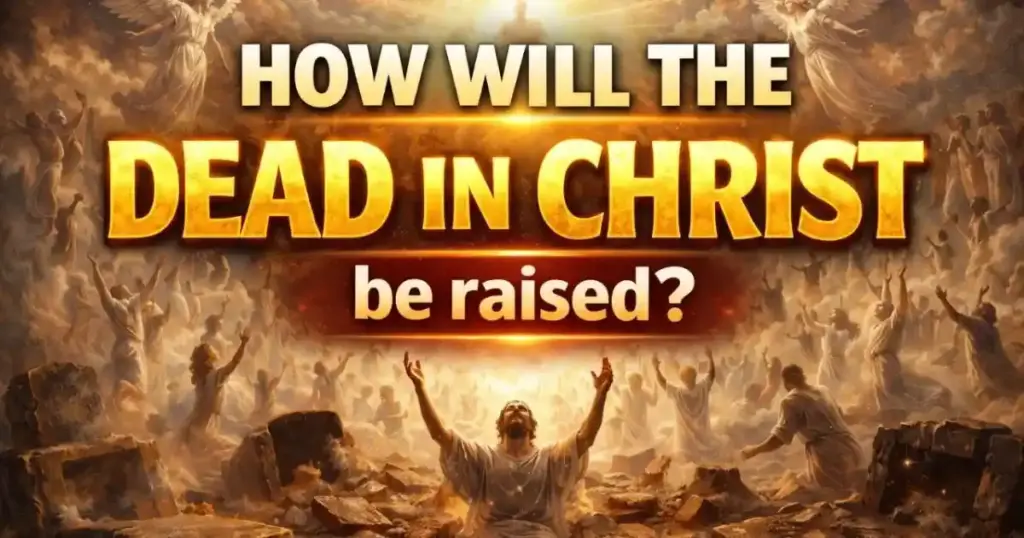
Understanding the Nature of Man: Spirit, Soul, and Body
Before diving into the mechanics of resurrection, it is essential to establish a foundational truth: man is fundamentally a spirit. This concept serves as the cornerstone for understanding how the dead in Christ will be raised. The physical body that humans inhabit during their earthly existence serves merely as a dwelling place—a temporary habitation for the spirit to reside in while on earth.
When a believer dies, their physical body remains in the ground, but their spirit immediately departs. The body returns to dust, but the essence of who that person truly is—their spirit—continues to exist. This distinction becomes crucial when examining the resurrection process, as it explains how believers who died centuries ago can still experience resurrection despite the decomposition of their physical forms.
Related: who the 24 elders of Revelation
The body, while important for earthly existence, is not the totality of human identity. You are a spirit, possessing a soul, and living in a body. This tripartite understanding of human nature helps illuminate how will the dead in Christ be raised when the Lord returns.
The Biblical Foundation: 1 Thessalonians 4:16
The Apostle Paul provides remarkable clarity regarding the resurrection sequence in his first letter to the Thessalonians. In chapter 4, verse 16, he declares that when the Lord Himself descends from heaven with a cry of command, with the archangel’s call, and with the sound of the trumpet of God, the dead in Christ will rise first.
This passage establishes a clear order of events during the rapture:
Get instant dream insight with our Free Dream Interpretation App
- The Lord descends from heaven with three distinct sounds: a cry of command, the archangel’s call, and the trumpet of God
- The dead in Christ rise first—believers who have died will experience resurrection before living believers are transformed
- Living believers are then caught up—those who remain alive will be transformed and join the resurrected saints
Paul emphasizes that living believers will not precede those who have fallen asleep. The phrase “fallen asleep” serves as a beautiful metaphor for death among believers, suggesting that physical death is merely a temporary state—like sleep—from which one will awaken.
The Challenging Question: Bodies Destroyed or Scattered
A profound question naturally arises when considering how will the dead in Christ be raised: What happens to believers whose bodies were not preserved? Throughout history, countless Christians have suffered martyrdom in ways that left no remains to bury:
- Christians thrown to lions in Roman arenas, their bodies torn to pieces and consumed
- Believers burned at the stake, their physical forms reduced to ashes and scattered by the wind
- Martyrs thrown into oceans, their remains distributed across vast waters
- Saints dismembered, with parts of their bodies distributed to different locations as warnings to other believers
- Believers who perished in fires, explosions, or other catastrophic events
How can these individuals experience bodily resurrection when nothing remains of their original physical form? This question deserves a thorough biblical answer.
Ezekiel’s Valley of Dry Bones: A Prophetic Blueprint
To understand how will the dead in Christ be raised, we must turn to one of the most vivid and instructive passages in all of Scripture: Ezekiel chapter 37, verses 1 through 14. This remarkable vision provides insight into God’s resurrection power and methodology.
The Setting of the Vision
The prophet Ezekiel records that the hand of the Lord came upon him and brought him out by the Spirit of the Lord, setting him down in the midst of a valley. This was no ordinary valley—it was full of bones. The Lord led Ezekiel around among these bones, and the prophet observed two significant details:
- There were very many bones—the valley was covered with skeletal remains
- The bones were very dry—indicating that considerable time had passed since death; these were not recent remains but ancient, desiccated bones
The extreme dryness of the bones emphasizes the apparent impossibility of the situation. From a human perspective, there was absolutely no hope for these remains. They were beyond dead—they were ancient, scattered, and completely lifeless.
Related: Does Satan Have Access to Heaven Today?
The Divine Question and Command
God posed a provocative question to Ezekiel: “Son of man, can these bones live?” Ezekiel’s humble response reflects appropriate reverence: “O Lord God, you know.” The prophet wisely deferred to divine knowledge rather than presuming to answer based on natural understanding.
God then issued a remarkable command: “Prophesy to these bones, and say to them, O dry bones, hear the word of the Lord.” This instruction reveals something profound—even inanimate, lifeless bones can receive and respond to the word of the Lord.
The Prophetic Declaration
The Lord instructed Ezekiel to declare a specific message to the bones:
- “Behold, I will cause breath to enter you, and you shall live”
- “I will lay sinews upon you”
- “I will cause flesh to come upon you”
- “I will cover you with skin”
- “I will put breath in you, and you shall live”
- “You shall know that I am the Lord”
This declaration outlines the resurrection process in remarkable detail, showing the systematic restoration of the human body from its most basic components.
The Resurrection Process Revealed
Stage One: The Gathering of Bones (Coaptation)
When Ezekiel prophesied as commanded, something extraordinary occurred. There was a noise—a rattling sound—and the bones began to come together. The text specifically states that each bone connected to its corresponding bone.
This phenomenon is sometimes referred to as coaptation—the bonding together of bones. The scattered remains throughout the valley began moving, finding their proper connections, and assembling into complete skeletal structures.
What makes this particularly remarkable is the precision involved. Each bone knew exactly where it belonged. Every femur found its matching hip socket. Every vertebra aligned in proper sequence. Every finger bone connected to its corresponding hand.
Stage Two: The Restoration of Flesh and Skin
After the bones assembled, the process continued. Sinews (tendons and ligaments) appeared upon the bones, providing the connective tissue necessary for movement. Then flesh formed over the skeletal-sinew structure, and finally, skin covered everything, creating complete human bodies.
This progression follows the reverse order of decomposition:
- First, bones come together
- Then sinews attach
- Next, flesh forms
- Finally, skin covers all
Stage Three: The Return of Breath
Despite the complete restoration of physical bodies, one element remained missing: breath. The bodies lay there—fully formed, anatomically complete—but lifeless. They had form without function, structure without spirit.
God then commanded Ezekiel to prophesy to the breath itself: “Come from the four winds, O breath, and breathe upon these slain, that they may live.” When Ezekiel obeyed, breath entered the bodies, and they lived, standing upon their feet—an exceedingly great army.
Nature Possesses Intelligence by Memory
One of the most remarkable revelations from Ezekiel’s vision is this profound truth: nature possesses intelligence by memory. This statement carries tremendous implications for understanding how will the dead in Christ be raised.
The Memory Encoded in Creation
Everything in God’s creation carries a form of intelligence encoded within it. Human beings obviously possess intelligence, but nature itself—including the physical elements that compose human bodies—contains what might be called “memory markers” or “identity signatures.”
Consider this astounding reality: if a believer’s body was scattered across different continents—perhaps a finger in Australia and another in Africa—those scattered remains retain their identity. They “remember” their connection to each other. When the Lord commands resurrection, those particles will find each other across any distance.
DNA Signatures and Divine Restoration
Modern science has revealed the existence of DNA—the genetic code that makes each person unique. Every cell in the human body contains this identifying information. The biblical vision of dry bones coming together suggests something even more profound: a divine tracking system that transcends physical proximity.
The bones in Ezekiel’s vision “knew” their DNA signatures. Each bone recognized its proper connections and moved accordingly. This wasn’t random assembly—it was precise, intentional, identity-based reconstruction.
Dust Particles Returning to Their Source
When flesh decomposes, it returns to dust. But that dust doesn’t lose its identity in God’s economy. When resurrection occurs, those dust particles—even if scattered kilometers away—will return to their proper place. They will clothe the reassembled bones with flesh exactly as they did during the person’s earthly life.
This understanding provides tremendous comfort when considering believers whose bodies were destroyed. Whether burned to ashes, consumed by animals, dissolved in water, or scattered by explosion—every particle retains its divine identifier and will return to its proper place at resurrection.
The Original Context of Ezekiel’s Vision
While Ezekiel’s vision provides a template for understanding physical resurrection, its original context addressed the spiritual condition of Israel as a nation. The dry bones represented the house of Israel in a state of spiritual death—separated from God, without hope, and seemingly beyond restoration.
God used this vivid imagery to communicate His intention to restore Israel:
- They had forsaken their God
- They were spiritually dead as a nation
- They needed a revival—a resurrection of sorts
- God would breathe life into them again
The vision served as both comfort and promise to the prophet and his contemporaries. God had not abandoned His people; He would restore them.
From Vision to Reality: The Rapture
While Ezekiel experienced this resurrection as a prophetic vision—an open vision granted for spiritual instruction—the rapture will transform this vision into concrete reality. The same processes Ezekiel witnessed symbolically will occur literally when Christ returns.
The Sequence of Events
Understanding how will the dead in Christ be raised becomes clearer when we trace the sequence:
- Christ descends from heaven with commanding authority
- The spirits of departed believers accompany Him—since man is a spirit, those who died in Christ have been with the Lord, and their spirits return with Him
- The physical remains of deceased believers are resurrected—using the process revealed in Ezekiel’s vision
- These bodies are transformed—the Greek word “allasso” indicates a change of material from mortality to immortality
- The resurrected bodies reunite with their spirits—the transformed bodies join their “owners” in the sky
- Living believers are then caught up—those who remain alive are transformed and snatched up to meet the Lord
Transformation: From Mortal to Immortal
The resurrected bodies won’t simply be restored versions of the original—they will be transformed. The Bible describes this change as putting on immortality, exchanging corruptible bodies for incorruptible ones, and receiving glorified, celestial bodies.
Living believers who are caught up in the rapture will experience instantaneous transformation—their mortal bodies changed to immortal ones in the twinkling of an eye. Those who died in Christ will experience both resurrection and transformation—their scattered remains gathered, reassembled, and then glorified.
Practical Implications for Believers
Understanding how will the dead in Christ be raised carries significant practical implications for those who follow Christ today.
Comfort in Grief
When believers lose loved ones who died in faith, this understanding provides profound comfort. No matter how death occurred—whether peaceful or violent, whether the body was preserved or destroyed—resurrection is certain. God’s resurrection power transcends any earthly circumstance.
Confidence in God’s Power
The resurrection demonstrates God’s absolute sovereignty over creation. Nothing is lost to Him. No particle escapes His notice. No identity is forgotten. The same God who created everything from nothing can certainly restore everything from scattered remains.
Motivation for Faithfulness
Knowing that resurrection and transformation await provides powerful motivation for faithful living. The struggles and sufferings of this present life are temporary. An eternal, glorified existence awaits those who persevere in faith.
Answer to Skeptics
When questions arise about the possibility of resurrection—especially for those whose bodies were destroyed—believers can confidently point to the biblical explanation. Nature’s intelligence by memory, combined with God’s unlimited power, makes resurrection not only possible but certain.
The Reunion in the Sky
The beautiful culmination of the resurrection event is a grand reunion. Spirits reunite with transformed bodies. The dead in Christ are joined by living believers who are caught up. All believers from all ages meet the Lord in the air.
This gathering represents the fulfillment of Christ’s promise to return for His people. It demonstrates God’s faithfulness to preserve and resurrect every believer. It inaugurates the eternal state where mortality is forever swallowed up by immortality.
Conclusion: Certainty in the Resurrection
The question of how will the dead in Christ be raised receives a comprehensive biblical answer. Through the prophetic vision of Ezekiel’s dry bones and the apostolic teaching of Paul, Scripture reveals a resurrection process that accounts for every possible scenario.
Whether a believer’s body rests peacefully in a grave or was scattered across the earth through persecution, the outcome remains the same: resurrection, transformation, and eternal glory. Nature’s embedded memory, combined with God’s sovereign command, ensures that not a single particle of any believer will be lost.
The spirits of departed believers currently rest with the Lord, awaiting the day when they will return with Him to be reunited with their transformed bodies. Living believers await their own transformation, when mortality will put on immortality and corruption will put on incorruption.
This understanding transforms the way believers view death. It is not an ending but a transition—a falling asleep from which awakening is guaranteed. The dead in Christ will rise first, and together with transformed living believers, they will meet the Lord in the air, forever to be with Him.
For anyone wondering how will the dead in Christ be raised, the answer lies in the unlimited power of the Creator who formed humanity from dust in the beginning and will restore humanity from dust at the end. The same voice that commanded light to shine out of darkness will command scattered remains to reassemble and dead bodies to live again.
This is the blessed hope of the believer—not mere spiritual survival after death, but complete bodily resurrection into eternal glory. Understanding this truth brings comfort in loss, confidence in faith, and eager anticipation for the return of Christ when all believers, both dead and living, will be forever united with their Lord.